
Do you ever find yourself watching a Hollywood action blockbuster, with a budget in the eye-watering hundreds of millions, featuring a cast of ivory-toothed matinee idols and a crew of some of the hardest-working and most technically-accomplished people in their fields, all working to create a dazzling spectacle for your entertainment, and catch yourself thinking “I’m kinda bored?”.
I do.
And I need to stress: I love an action movie. I want to be swept up in a pulse-pounding spectacle. I love to follow a well-choreographed fight, thrilling to every thrust and parry. I love to grab my seat rests in exhilaration to the rhythm of a dogfight in space or a hair-raising encounter with a giant monster.
Lately (and by that I mean the last, oh 15-20 years of Hollywood filmmaking) I’ve noticed that there’s something missing from a lot of action movies. Obviously, a lot has changed about action films in that time; the increasing rise of homogenized, IP-based films, the increasing tendency to overuse CGI and to impose ridiculous deadlines on an under-paid and un-unionized workforce, for example.
But I believe the problem is rooted in something deeper. Something structural.
Cast your mind back, beloved reader, to the hallowed halls of high school. Remember in your English class, when you were first talking about the structure of fiction (three acts, inciting incident, rising action, climax, denoument, things of this nature) and your teacher would inevitably draw a diagram that looked something like this:
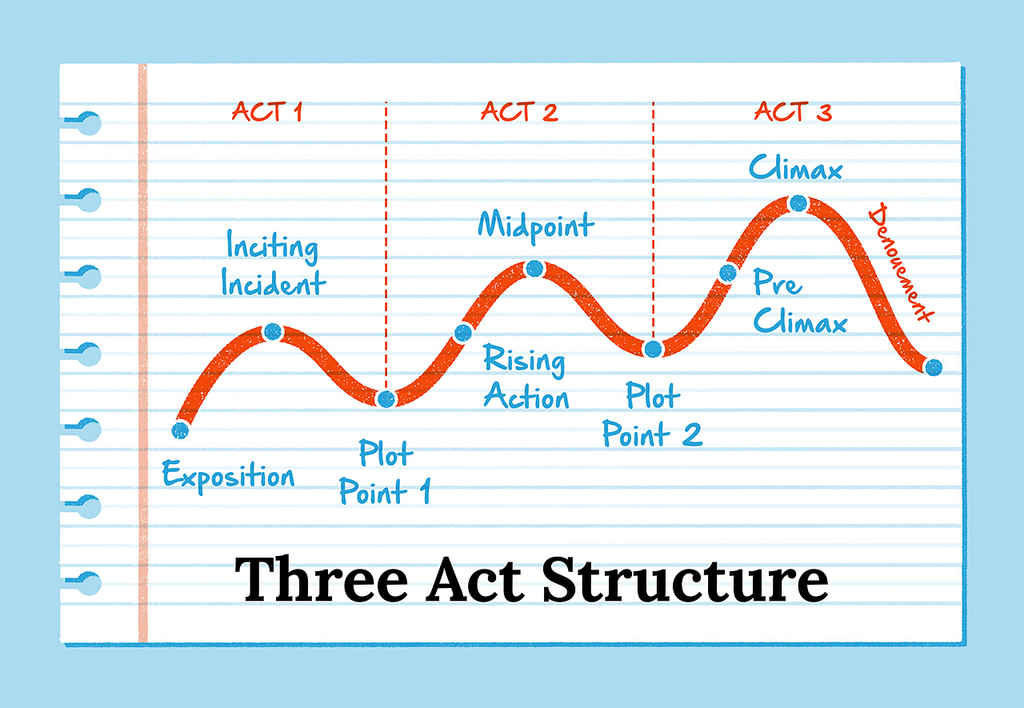
This structure, with its peaks and valleys, each one building on the previous one, is predicated on a simple conceit: the stakes are always being raised. Each of those story beats that comes at the top of a peak represents a moment in the story where something more valuable is threatened or put at risk, or the threat which puts things at risks becomes larger, more complex, more dangerous. The villains reveal a new weapon. The hero’s lover is kidnapped. The henchman you thought you’d disposed of returns, upgraded.
In the context of the action genre (and its many siblings and spin-offs – science-fiction or fantasy action films, superhero movies, martial arts films, etc) this should neatly map on to your action set-pieces. Each set piece should raise the stakes from the previous action set piece, both in terms of the physical and the narrative or emotional stakes present.
To put it in simple terms – every action beat should be cooler than the last.
Every action beat should feel more exciting, more important, than the last.
Seems like this should be a pretty straightforward principle to apply, right?
You would think.
I submit that Hollywood, for whatever reason, has been neglecting this foundational building block of the action film. (There are a few exceptions, and don’t worry, we’ll get to those.) The result is often an action movie whose most thrilling sequence comes too early, or a movie whose climax is undercut by a lacklustre setpiece or emotional beat, or worst of all – an action movie whose action scenes are just not … that … memorable.
This phenomenon is most obviously present in the Disney blockbusters (such as the Marvel Cinematic Universe and Star Wars franchises) that have eaten up 90% of the oxygen of Hollywood for far too long. (Cards on the table here, I am a big fan of the superhero genre, superhero comics, and the Star Wars universe, but to put it kindly, the influence of the Disney corporate apparatus has done these franchises no favours, in terms of their ability to tell interesting, complex, or well-executed films. No doubt that will be the subject of a future piece.)
So, let’s look at how some relatively recent films have failed this basic action-movie structural smell-test.
Shang Chi and the Legend of the Ten Rings (2021)
Think of Shang Chi and the Legend of the Ten Rings, whose strongest, most interesting and most memorable action scenes are the ones which take place in an interesting location with cool physical limitations (namely the inside of a moving bus and the outside of a building’s scaffolding).
These fights are well choreographed and surprising. They introduce multiple elements that make it more than just a fight scene – civilians or allies our hero has to protect, an important prop that our hero has to hang on to – as well as taking place in a location that forces the fight to be dynamic and inventive.
The fight on the bus is widely regarded as the best in the movie – which is crazy when you consider that it’s basically at the end of the first act. It also serves to advance the character arcs – Shang Chi must reveal his fighting skills to his friend Katy, who must reckon with the fact that she doesn’t really know this guy at all.
Unfortunately, many of the subsequent fights are not particularly tied to the characters’ emotional journey or the themes of the film. And the ones that are – such as Shang-Chi’s final showdown with his villainous father Wenwu – are robbed of weight and impact by taking place on a greenscreen soundstage and incorporating a supremely boring CGI monster.
One thing Shang Chi has in common with a lot of the Marvel movies is that there are too many action beats. Some focus group or boardroom committee seems to have decided that it’s necessary to have an action beat once every 15-20 minutes. This dilutes the impact of each scene and makes it harder to give them a satisfying structure that aligns with the film’s narrative and themes. This crops up even in the Black Panther films, which I think are some of the stronger MCU entries.
Black Panther (2018)
Black Panther has a slightly different problem than Shang Chi – but it’s still structural. All the coolest and most memorable action sequences happen at roughly the mid-point of the film. First, you get the high-spectacle of the car-chase fight through Seoul, and then the climactic fight between T’Challa and Killmonger at Warrior Falls.
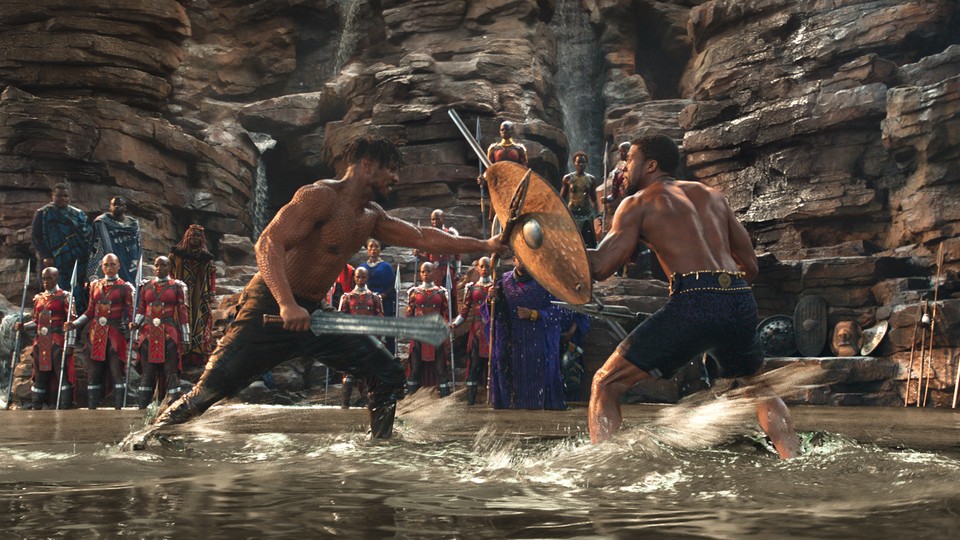
This fight in particular is electric in its physicality, with the two leads performing tense and exciting choreograph next to a big scary waterfall. It’s obviously Chadwick Boseman and Michael B. Jordan doing the fight at least most of the time, meaning the camera has more freedom to move and show the actors from a variety of angles.
It also features the highest stakes of the film so far – a challenge to T’Challa’s right to the mantle of King and Black Panther. This fight is foreshadowed by M’Baku’s challenge at the start of the film – and while that scene serves to demonstrate that T’Challa is suited to the role, this scene directly undercuts that premise. In this fight, the challenge comes from someone who is forcing him to directly reckon with his own family’s legacy of realpolitik and ruthlessness – and that cuts to one of the central themes of the film – can you be a King and be a good person? So here, the stakes are narratively high as well as physically exciting.
Unfortunately, while the narrative structure of Black Panther is solid, none of the subsequent action scenes are this thrilling – and the final confrontation between Black Panther and Killmonger is a weightless mess of CGI puppets, obviously not the real guys. (This sequence was apparently conceived and storyboarded before the film was even written, a problem which plagues the MCU franchise and which Ryan Coogler does his best to surmount.) This lacklustre climax robs the film’s of the excitement and emotional catharsis that should be the due of any action film.
Mortal Kombat II (2026)
While this summer’s Mortal Kombat II is not actually a Disney blockbuster, it suffers from the same flaws. It’s aesthetically similar – a somewhat lifeless, green-screen heavy mess. But you might expect that, since it’s based on a fighting game, and the original fighting game was heavily drawing on the tradition of Hong Kong action cinema, they might at least respect the law of fight scenes following the same narrative structure as any good screenplay?
Alas … no.
Like the worst Marvel films, this movie is overstuffed with fight-scenes and lacks a solid narrative structure. And because it can’t decide who its protagonist is, and is trying to introduce several fighting games worth of characters, it fails to give any of those characters a well-developed arc.
Now, at least the fights here are performed by some very competent performers, and some of them have the juice of serious choreography – but all of that sturm und drang means very little to the audience, because the movie has given you very little reason to care about these characters, and what they’re fighting about.
Mortal Kombat also commits the cardinal sin of putting the most technically interesting and accomplished fight in the mid-point of the film. The duel between Liu Kang and Kung Lao is well choreographed and uses Kung Lao’s flying circular-saw of a hat as a cool obstacle/prop. But these are not the protagonists of the movie! The emotional stakes of their fight are tied to something that happened in the last film!
The final fight scenes fail to measure up, because the screenwriters have written themselves into a quandary. The movie sort of has two protagonists – Johnny Cage and Kitana. The movie starts by introducing Kitana and her tragic backstory, which sets us up for her to be the hero. We are also introduced to her nemesis, and the primary antagonist, in Shao Khan, who kills her father. Johnny Cage is introduced as a sort of Han Solo-style secondary protagonist, who we’re also rooting for, but it is Kitana whose narrative arc is obviously tied to the plot most directly.
However. Because Johnny Cage is played by Karl Urban, the closest thing this movie has to a bankable star, he quickly takes up more of the screen time, and gets the most character development of anyone – which is still not much. But it’s his redemption arc we get invested in (in theory), so it’s his arc that should be tied to the big final fight scene, where we get the emotional and narrative payoff tied in with what should be the physical climax of a visually thrilling fight with the big bad of the movie, Shao Khan.
Here’s the problem: I love Karl Urban, but my guy is in his fifties, and is not a trained martial artist. His fight scenes are lacklustre, relying too much on CGI and obvious stunt doubles. It’s a shame! But it’s obvious that he can’t carry the finale. (Which is partly why Hiroyuki Sanada’s Scorpion shows up to steal his thunder in their big multi-combatant showdown in act three. Only Scorpion’s dramatic arc was also resolved in the last film, and he isn’t reintroduced until the last act of this film, so there’s no time to make us care about him!)
And – it’s Kitana who is narratively the most tied to the antagonist, Shao Khan. So it’s her who gets the big fight with Shao Khan. But because her character development got short shrift, it’s hard to get invested in that big fight. It’s not that memorable, apart from a pretty gnarly fatality which i confess did get me hooting and hollering. I’m not made of stone.
In fact, I go in to even the most mid summer movie wanting it to succeed. I’m an easy sell for a superhero movie! But you gotta respect your audience enough to craft these things carefully!
By focusing on one protagonist, and anchoring their character development to the same structural spine as the action beats, 2026’s Mortal Kombat II could have been much, much stronger. If you want proof, look no further than 1995’s Mortal Kombat. By no means a “good movie”, but one I have a lot of affection for, and one that came from an earlier era of Hollywood filmmaking where even the shlockiest cash-grab action B-movie had a better understanding of narrative structure than the summer of 2026’s biggest tentpoles.
This piece is getting rather long, and I have lots more to say. Stay tuned for part 2, where I turn the lens to some movies that get this concept of tying the structure of the action to the structure of the story – starting with 1995’s Mortal Kombat and ending with a trifecta of some of the best blockbusters of all time.
 Jeremy Large Writing & Consulting Services
Leave a comment